Court Call Club Demonstration · Synthetic data only · Operational messages disabled
CourtCall For Clubs
Private racquets operations, without the text-chain chaos.
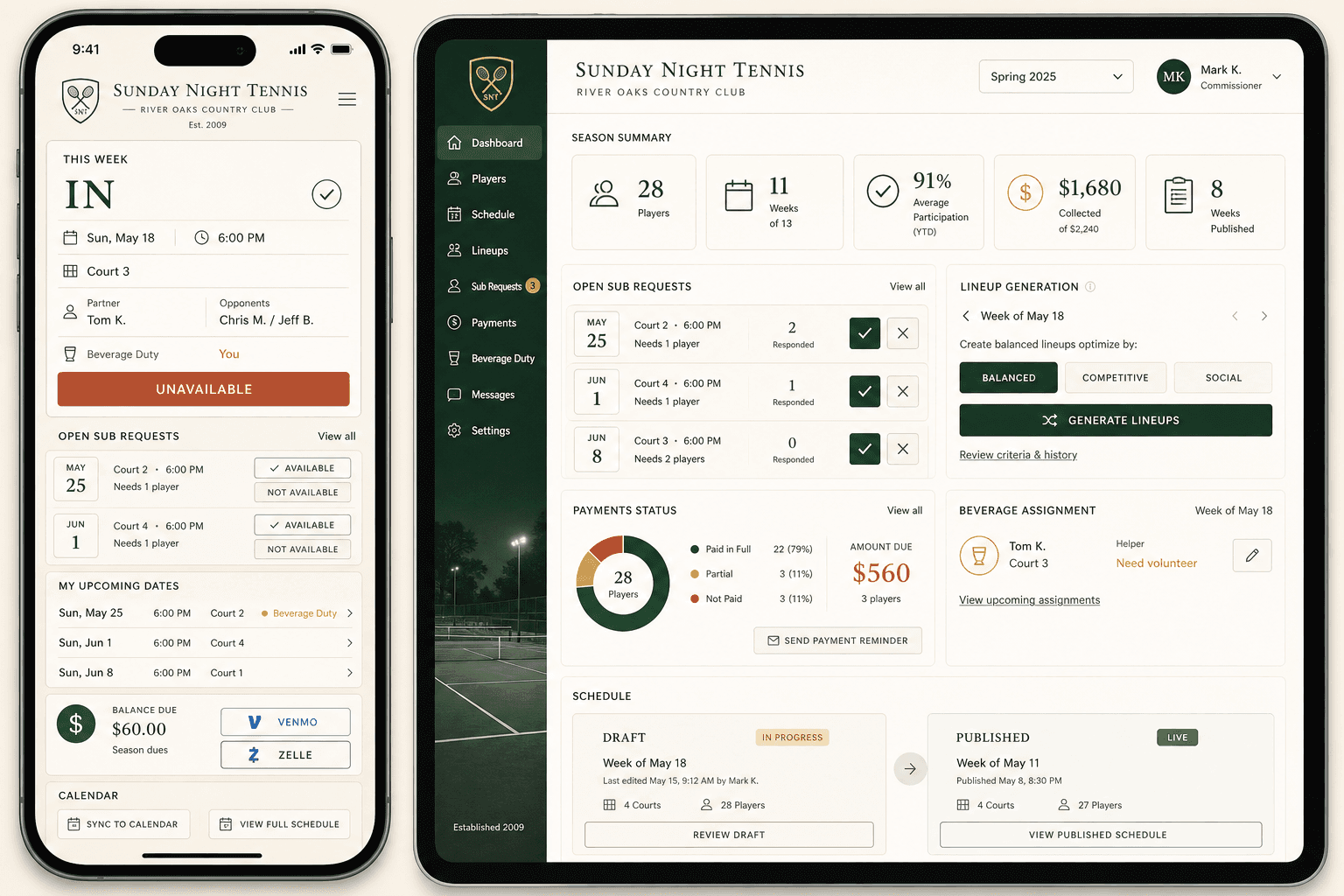
CourtCall gives racquets directors, commissioners, and captains one place to publish recurring series, open event signup, fill open seats, sync calendars, track player obligations, and keep members aligned without text-chain chaos.
One branded club app with one member login
Invite-only access seeded from the roster
Recurring series and event signup inside the same tenant
Seed the roster once. Access follows the club-approved player list.
Calendar-ready
Personal and full-series schedule feeds keep members aligned after publish.
Operating Loop
CourtCall replaces scattered coordination with one controlled workflow.
The product is not just a prettier schedule. It is an operating loop for publish, substitution, notification, and calendar truth across recurring racquets play.
1Publish once
Release the full season after admin approval, with courts, pairings, duties, fees, and venue details already attached.
2Fill fast
A player taps Unavailable, the seat posts instantly, and the right replacements are invited in the right order.
3Run events cleanly
The same club app can handle recurring series and one-off racquets events without forcing members into a different workflow.
4Expand cleanly
Start with one flagship series, then roll into Tuesday, Thursday, pickle, paddle, mixers, ladders, and special events.
Club Product Model
One branded club app, two program modes, and one shared roster.
CourtCall should be sold as one club tenant with one member login and one admin console. Inside that same app, staff creates either recurring Series Mode programs or one-off Event Mode programs.
Series Mode
Recurring weekly or seasonal play
Use this for house leagues, doubles nights, interclub squads, and any program where the club wants the season mapped out in advance.
Publish the full season up front
Generate lineups and substitutions cleanly
Lock the schedule after publish
Event Mode
Mixers, round robins, clinics, and special nights
Use this for one-off and short-window events where the main workflow is fast signup, capacity control, waitlist handling, and clean day-of adjustments.
Open one-tap member signup
Cap the field and manage a waitlist
Create teams or courts after signup closes
One branded club tenant
Each club gets its own CourtCall environment with its own branding, venues, court groups, admins, and communication settings.
One member identity
Members register once with email, phone, club number, and optional NTRP, then use the same login across tennis, pickle, paddle, and events.
One roster, many programs
Staff seeds the roster once, then allocates players into recurring series, team formats, or one-off events without rebuilding the member directory each time.
One low-friction operating layer
The member experience stays one tap to join, one tap to decline, one tap to request a sub, and one tap to sync the calendar.
Top Use Cases
Three club scenarios where CourtCall is immediately useful.
The strongest first deployment is a recurring series with predictable weekly court time. From there, the same operating model can spread across a broader racquets program.
Use Case
Recurring house leagues and doubles nights
Publish the whole season up front, then stop rebuilding the week over text messages.
CourtCall is strongest when a club runs a recurring weekly format that uses fixed court time, recurring rosters, and regular substitutions.
Members always know whether they are in or out this week.
Calendar subscriptions keep the season visible without extra staff effort.
Use Case
Interclub teams and organized match play
Give captains and staff one operating layer for lineups, substitutions, payments, and last-minute changes.
The same workflow works for club-vs-club tennis, internal team series, and structured match play where partner, opponent, and court assignments matter.
Captains can publish, lock, and update match weeks cleanly.
Rostered players see the current lineup instead of old email threads.
Staff keeps oversight without handling every change manually.
Use Case
Mixers, clinics, ladders, and special events
Extend one member-facing app across recurring series and event signup.
Once the club trusts one mobile workflow, CourtCall can support additional racquets use cases without forcing members into a new tool each time.
Open seats can be filled quickly from an opted-in pool.
Members get one familiar installable experience across programs.
The club can brand tennis, pickle, and paddle under one operating surface.
First Three Club Fits
How the first three club conversations should be framed.
These three clubs should not hear a generic software pitch. Each one should hear a rollout path tied to its size, court footprint, and likely first buy.
Silver
Larchmont Yacht Club
Approximately 1,000 members, 6 clay courts, and enough scale to justify coordinated tennis programming beyond a single weekly night.
Silver is the right first buy if the club wants CourtCall as a tennis-department operating layer instead of a one-series pilot.
Start with one flagship recurring tennis series in Series Mode, then add interclub or team-admin workflows before opening Event Mode for mixers and special events.
Silver
Orienta Beach Club
Approximately 500 members and 10 Har-Tru courts, which creates strong capacity for multiple concurrent programs and special nights.
Silver is still the best first buy because the court inventory supports several active programs even at a smaller member count.
Launch one recurring tennis series first, then add Event Mode quickly for round robins, mixers, and special nights in the same branded app.
Bronze
Larchmont Shore Club
Approximately 500 members and 7 tennis courts, with strong potential for a flagship pilot and later expansion.
Bronze is the clean pilot entry point if the club wants proof first. Move to Silver when they want CourtCall across organized tennis more broadly.
Start with one recurring flagship program in Series Mode, prove the no-friction member behavior, then expand into additional series or Event Mode.
Director of Racquets value
Cuts back the weekly labor of phone calls, text chains, and spreadsheet cleanup.
Creates one source of truth for recurring schedules, event signup, lineup changes, venue details, and player obligations.
Lets staff publish a polished mobile experience without building a native iPhone or Android app first.
Supports controlled expansion from one flagship series into a full racquets operations layer.
Member value
One-look clarity on whether the member is in or out for the week.
One-tap substitution posting instead of awkward back-and-forth texts.
Register once with the club, then use one-tap actions across recurring programs and special events.
Personal schedule and full-season calendar subscription options.
Mobile install flow that feels like an app, even before native packaging is considered.
Pricing
Three packages that map to how clubs usually buy.
CourtCall should sit above free team tools and below the burden of a full club-suite replatform. The pricing below positions it as a focused racquets operations layer with optional expansion.
Bronze
One flagship tennis pilot or a small-club launch.
Best when a club wants to replace text-chain administration for one recurring league, house series, or signature doubles night, while keeping room for light event usage in the same app.
$349.00per month
$4,200.00 annual subscription
$1,500.00 one-time launch fee
1 club tenant
1 flagship recurring series
Light Event Mode support for the same sport
Up to 400 opted-in players
Admin publishing and schedule lock controls
Email notifications, ICS calendar feeds, and installable web app
Standard onboarding and launch configuration
Best Fit
Silver
A racquets department with tennis teams, leagues, and recurring events.
Best for a club that wants CourtCall as the operating layer for organized tennis across multiple weekly series, team formats, and event signup flows.
$749.00per month
$8,988.00 annual subscription
$3,500.00 one-time launch fee
1 club tenant
Up to 8 active series across tennis programs
Event Mode included
Up to 1,500 opted-in players
Role-based control for director, captains, and commissioners
SMS capability with pass-through messaging charges
Branding controls, admin reporting, and launch support
Gold
A multi-racquet club or premium white-label deployment.
Best when the club wants CourtCall extended across tennis, pickle, paddle, special events, and deeper white-label treatment.
$1,495.00per month
$17,940.00 annual subscription
$7,500.00 one-time launch fee
1 club tenant
Multi-racquet program support
Expanded branding and white-label configuration
Priority onboarding and operating support
Advanced launch planning for venues, special events, and series growth
Optional Teams/admin workflow extensions where appropriate
Recommended For A 1,500-Member Club
Silver is the default recommendation when the club wants CourtCall across organized tennis programs. Gold becomes the right fit when pickle, paddle, special events, or deeper white-label expectations are part of the launch.
Commercial Notes
Messaging, toll-free number, and carrier registration costs pass through at cost.
Annual pricing assumes one-year commitment and standard implementation scope.
Custom data migration, native mobile packaging, or deep club-system integrations are scoped separately.
Pilot Path
Start with one flagship series, then expand only after the workflow proves itself.
CourtCall is easiest to sell and adopt when the club begins with one recurring tennis program that already hurts operationally. Once members and staff trust the workflow, expansion becomes a straightforward operating decision instead of a conceptual one.
Step 1
Launch one flagship recurring tennis series first.
Step 2
Train the racquets director plus one commissioner or captain.
Step 3
After the first recurring series is stable, add Event Mode for mixers, championships, or special nights in the same tenant.
Step 4
Run the first season as the club’s operating proof point, then expand into additional series or racquet sports.